Organic Content Specialist•١٩ مارس ٢٠٢٦•8 min read
Fact checked by Dr. Maxwell Beresford
TL;DR
Medical scribing involves real-time documentation of patient encounters, traditionally on paper but now using EMR systems. It alleviates administrative burdens on clinicians, reducing burnout and enhancing patient care. AI tools like Heidi streamline this process, ensuring accurate, compliant documentation, and allowing clinicians to focus on patient interaction. This approach improves workflow efficiency, increases clinician satisfaction, and supports healthcare systems by integrating human expertise with AI capabilities.
Section Name: BlockContentHighlights
What is Medical Scribing?
Medical scribing is the process of accurately documenting patient encounters and other medical data, often carried out in real-time. It traditionally involved paper-based records, but modern practices utilize EMR systems. The documentation typically includes lab results, imaging reports, observations, treatment plans, history, and diagnoses.
Medical Scribing: Everything You Need to Know - Heidi | Heidi AI
In this article, we’ll discuss why medical scribing matters, how it works, and the types of medical scribing clinicians employ in modern healthcare.
In this article, we’ll discuss why medical scribing matters, how it works, and the types of medical scribing clinicians employ in modern healthcare.
Globally, administrative burden is a serious challenge faced by clinicians. It often leads to burnout and, in some cases, clinicians leaving practice altogether. Research shows that 49% of clinical time is spent with EHRs, with significant hours spent each day merely to clear the EHR inbox. The use of medical scribes shifts this imbalance by allowing clinicians to offer patients a more present, care-focused atmosphere.
Why Medical Scribing Mattersspend less time entering data into EHRs when scribes handle the paperwork.
Globally, administrative burden is a serious challenge faced by clinicians. It often leads to burnout and, in some cases, clinicians leaving practice altogether. Research shows that
Section Name: BlockImage
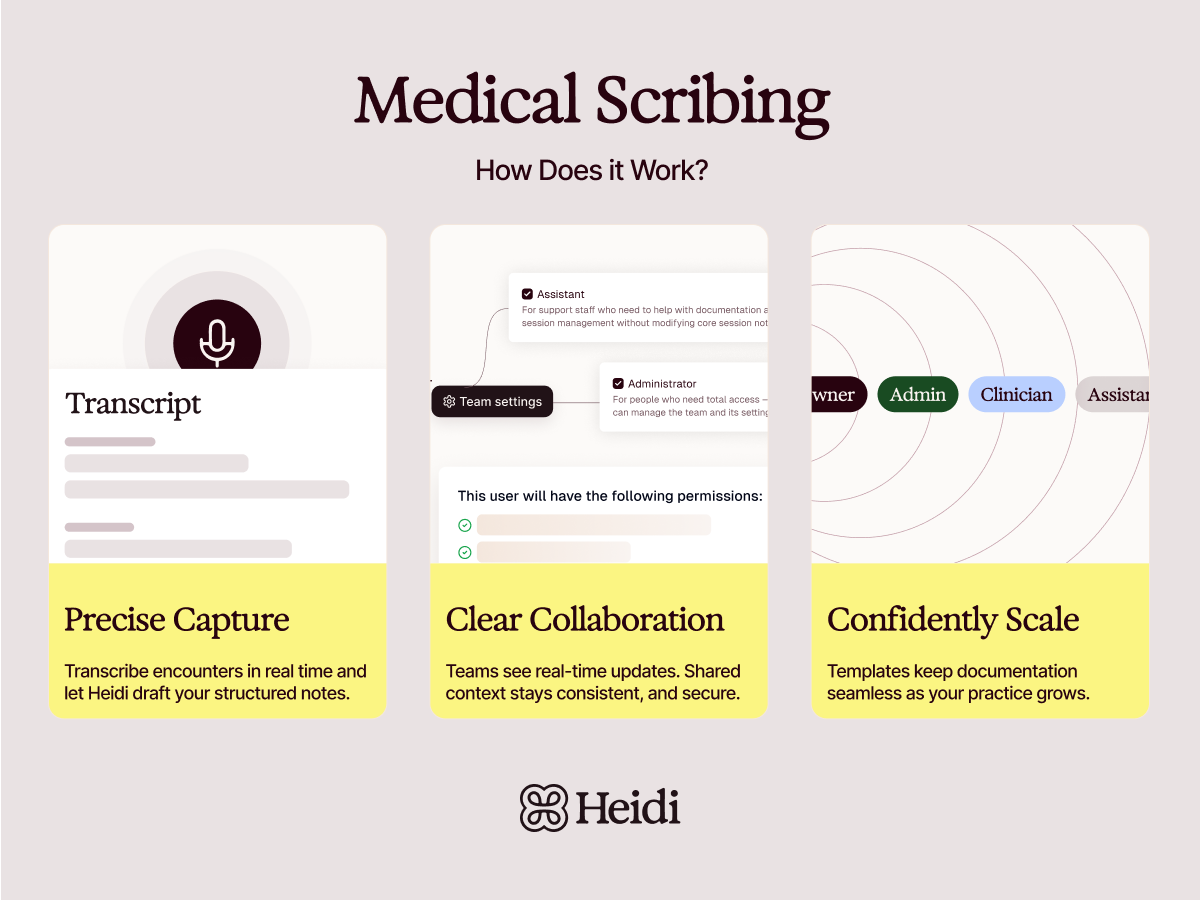
Heidi’s medical scribing captures every encounter in real time, keeps your team aligned, and scales documentation seamlessly across any care setting.
Because documentation is promptly executed and finished as soon as the consultation ends, clinicians can attend to more patients, and clinics can simultaneously boost their overall capacity. In turn, not only does the clinician-patient interaction improve, but clinicians tend to be more satisfied with better workflow due to the reduction of after-hours charting.
As clinical workflows evolve, so does the role of medical scribing. With high adoption rates, effective use of AI medical scribes is gradually proving to ensure high-quality care delivery. Clinicians appreciate advanced medical scribing services like Heidi because they streamline documentation, ensuring it is both complete and compliant after just one patient conversation.
How Does Medical Scribing Work?
As clinical workflows evolve, so does the role of medical scribing. With high adoption rates, effective use of AI medical scribes is gradually proving to ensure high-quality care delivery. Clinicians appreciate advanced medical scribing tools such as Heidi because they streamline documentation, ensuring it is both complete and compliant after just one patient conversation.
Below, let’s take a look at Heidi in action.ambient voice technology accurately transcribes medical encounters, Heidi’s scribe function then uses this transcript to generate medically pertinent documentation. In the same session, input is flexible, so along with the transcript, Heidi can accommodate your quick edits and incorporate data into the existing chart context. From a single encounter, Heidi drafts the core of your clinical note, mapped into your preferred template.
Step 1: Accurately capture medical data
During visits, Heidi’s ambient voice technology accurately transcribes medical encounters, Heidi’s scribe function then uses this transcript to generate medically pertinent documentation. In the same session, input is flexible, so along with the transcript, Heidi can accommodate your quick edits and incorporate data into the existing chart context. From a single encounter, Heidi drafts the core of your
This is what Heidi gets automatically done:
Basic evaluations and
Hands-free transcription and patient data entry
Notes are organized so you can easily review and approve documentationcontext is consistent and can be accessed by the team immediately, any time. The scribed note reflects the updated medical patient record, with role-appropriate visibility so that only certain staff can see what’s relevant to their workflow. This way, handoffs are more seamless and collaborative.
Step 3: Scale without growing painsclinical notes and admin burden taking over billable hours are a few care obstacles faced by the team at Advanced Urology. Before Heidi, they had to spend 3 hours of charting after over 35 sessions each day, and the frequent note-taking made it difficult to maintain engagement with the patients.
In modern healthcare settings, clinicians may travel to remote locations such as long-term care sites or the
The inconsistent quality of clinical notes and admin burden taking over billable hours are a few care obstacles faced by the team at
Dr. Neal Patel, Chief Technology Officer at Advanced Urology, happily shares the results: “It has enabled our practice to shift our focus from documentation to providing the best, most personalized care for our patients by allowing our providers to focus on patients.”
Different Types of Medical Scribingmental health practices demand precise recording of complex histories, while certain procedures like those in orthopaedic practices necessitate procedural documentation.
Medical scribing must adapt to the varied pace and complexity of different care settings. Some departments prioritize speed, while others require in-depth documentation to capture easily overlooked details. For instance,
Virtual Medical Scribingvirtual medical scribes are human professionals who listen to recordings and review them to produce clinical documentation. They work either in real time or post-visits, commonly under contracts or agreements to ensure confidentiality and compliance.
Working asynchronously,
Virtual medical scribes take over the administrative load to free physicians to focus on medical tasks and direct interaction with patients.
Online Medical Scribing
Online medical scribing generally uses cloud-based platforms that require internet connectivity. This method enables clinicians to upload their voice recordings through interfaces like browsers or dedicated applications for later transcription.scale or be flexible across different departments or regions. This model supports transcriptions carried out or reviewed by human medical transcriptionists.
Cloud infrastructure makes for an easy way to
AI Medical Scribingtasks without typing, including referrals, follow-ups, and changes in medication.
AI medical scribing builds on online scribing with the addition of automation capabilities. It involves real-time transcription and summarization of consultations. It also extracts actionable items from which clinicians can follow up without typing, including , follow-ups, and changes in medication.declining workforce.
A prime example of this is Heidi, an AI medical scribe designed to help clinicians by automating documentation and modernizing workflows. This labor-saving tool alleviates the excessive mental strain that often drives clinicians to life-altering decisions like switching careers, ultimately helping in efforts to retain clinicians in the declining workforce.
The trade-off is clear: clinicians like you no longer have to juggle remembering prescriptions while explaining complex physiology to patients. With Heidi,
Designed to understand clinical nuance, Heidi impacts real-world workflows while being secure and dependable. Instead of constantly switching hats between caregiver and note-taker, you retain the inference, judgment, and control over your notes while Heidi handles your documentation.
Section Name: BlockContentHighlights
Try Heidi: The Clinician’s AI Care Partner
Clinicians like you deserve to focus on care, not keyboards. The cognitive load needed to mentally detail each patient encounter is what medical scribing is built to minimize. Clinicians haven’t felt true relief until they used an automated documentation system like Heidi in practice.
Ready when you are, Heidi assists you to:
Use ambient voice technology: As your normal patient visit goes, Heidi listens securely, identifying speakers and focusing on clinically relevant speech.
Dictate or transcribe with ease: Whenever you need it, switch to dictation, transcription, or upload audio files with ease so Heidi can structure your words into clear, compliant notes without extra clicks.
Scale without friction: Standardize templates and coding hints thanks to consistent workflows across teams.
Heidi Health supports over 100,000 clinicians globally and is fully compliant with regional standards in the US, the UK, Australia, Canada, and beyond. It holds enterprise-grade certifications, including SOC 2 Type II and ISO27001, with data localization and no audio ever retained.
Yes. While it requires extensive knowledge of terminology, medical scribing also incorporates context, so misrepresentation of clinical information or potentially writing harmful medical or financial mistakes is avoided. In modern workflows, time management and discretion with sensitive data are automatically handled as AI medical scribing performs real-time charting capabilities.